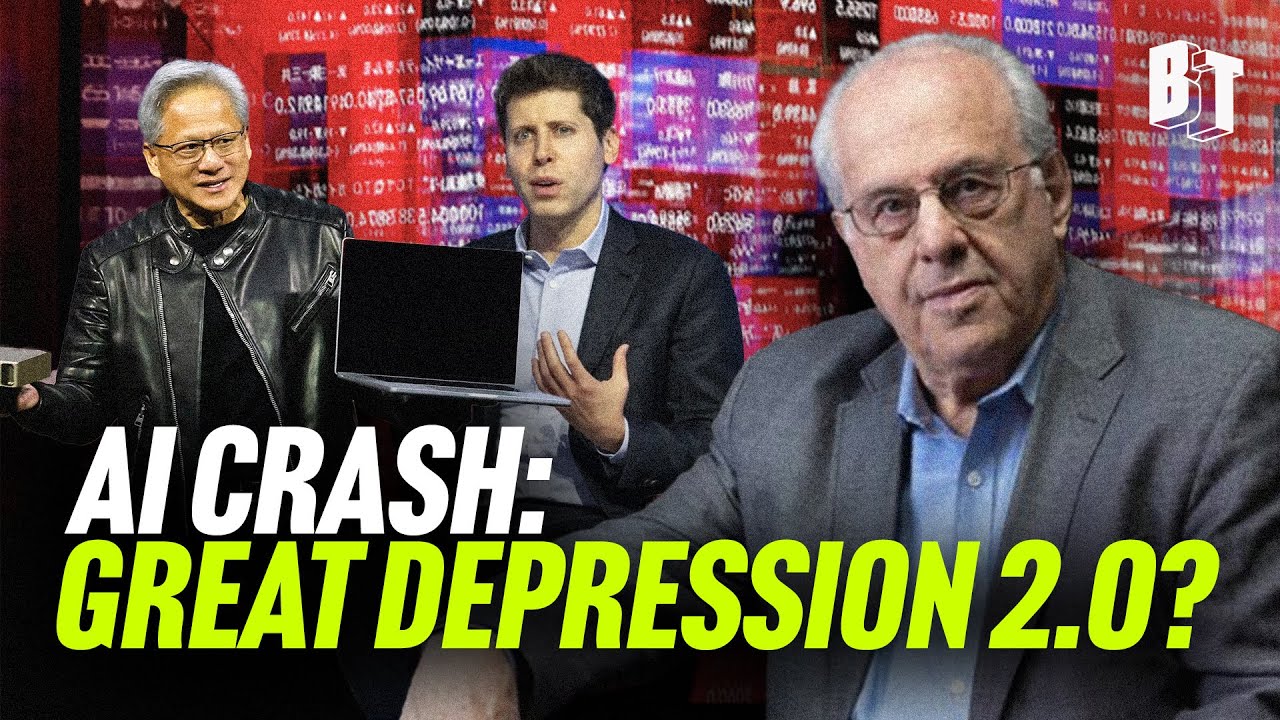
TL;DR: The article warns that massive speculative investment in AI, extreme market concentration in a few tech giants, and weak underlying economic fundamentals could trigger a financial bubble crash potentially worse than the Great Depression.
📋 Table of Contents
Jump to any section (17 sections available)
📹 Watch the Complete Video Tutorial
📺 Title: How an AI Bubble Crash Could Be Worse Than the Great Depression w/ Prof. Wolff
⏱️ Duration: 1068
👤 Channel: BreakThrough News
🎯 Topic: Bubble Crash Could
💡 This comprehensive article is based on the tutorial above. Watch the video for visual demonstrations and detailed explanations.
The U.S. economy stands on the precipice of a potential financial crisis unlike any in recent memory. With trillions of dollars poured into artificial intelligence (AI), stock valuations of a handful of tech giants soaring to unsustainable levels, and broader market fundamentals lagging far behind, experts warn that a bubble crash could be imminent—and far more damaging than past corrections. This article unpacks the full scope of the warning signs, historical parallels, structural vulnerabilities, and systemic risks outlined in a compelling expert analysis. From the role of the “Magnificent Seven” to the global shift in economic power and the human cost of AI-driven automation, every critical insight from the transcript is explored in depth.
Why a Bubble Crash Could Happen Now
We are statistically “due” for a market downturn. Historically, major stock market corrections occur every four to seven years. What makes the current moment especially volatile is the convergence of several high-risk factors: massive speculative investment in AI, extreme market concentration in a few mega-corporations, and a broader economy showing signs of stagnation. Together, these conditions “double the likelihood” of a crash—and suggest it “may be a doozy.”
AI as the Defining Technological Bubble of Our Era
Artificial intelligence is being hailed as the dominant technological shift of our time—comparable to the internet in the 1990s. But unlike past innovations, AI is attracting unprecedented capital flows without commensurate real-world productivity or profitability. The sheer volume of money being funneled into AI infrastructure has created a speculative frenzy that mirrors classic bubble behavior. As one analyst notes, “everything is there for the bubble mania to be what we’re looking at.”
Google’s $90 Billion AI Bet: A Case Study in Overinvestment
Sundar Pichai, CEO of Google, recently revealed that his company’s annual spending has tripled from under $30 billion to over $90 billion in just four years—primarily driven by AI infrastructure. He estimates that collectively, tech firms are investing “well over a trillion dollars” into AI systems. While Pichai insists there is “real demand” and that “the excitement is very rational,” he also concedes: “There are moments we overshoot… collectively as an industry we can look back at the internet… there was clearly a lot of excess investment.”
The “Magnificent Seven” Distortion of Market Reality
A critical red flag is the extreme concentration of stock market gains in just seven companies—dubbed the “Magnificent Seven” (including Apple, Amazon, Microsoft, Google, Nvidia, Meta, and Tesla). These firms have been artificially propping up major indices like the S&P 500 and Nasdaq, masking the underperformance of the broader market. When these seven are excluded, the rest of the U.S. stock market has been “in mediocre shape” for years—a sign of deeper systemic weakness.
Table: The Magnificent Seven’s Market Impact
| Indicator | With Magnificent Seven | Without Magnificent Seven |
|---|---|---|
| Stock Market Performance | Appears strong and bullish | Mediocre or stagnant |
| Investor Sentiment | Overly optimistic | Reflects underlying economic weakness |
| Risk Exposure | Concentrated in tech/AI stocks | Diversified but underperforming |
| Crash Vulnerability | Extremely high—“most likely to crash” | Lower, but dragged down if tech collapses |
Historical Parallels: 1929 vs. Today
The 1929 stock market crash triggered the Great Depression—a crisis that lasted 11 years and was only resolved by the economic mobilization of World War II. At that time, the U.S. was ascending as the world’s dominant economic power, having avoided the devastation of World War I that crippled Europe and Asia. Today, the situation is reversed: we are at “the end of the American century,” not the beginning.
Key Differences Between 1929 and 2024
- Global Position: In 1929, the U.S. was the unchallenged industrial and financial leader. Today, China and BRICS nations are “outmaneuvering us competitively” across multiple sectors.
- Economic Trajectory: The 1920s were part of a long-term global upswing for U.S. capitalism. Now, the U.S. faces structural decline, demographic challenges, and waning geopolitical influence.
- Recovery Mechanisms: WWII provided massive government-led employment and industrial expansion. No comparable “external shock” exists today to rescue the economy from a deep downturn.
Why Past Tech Bubbles Don’t Guarantee a Soft Landing This Time
Executives like Pichai often cite the dot-com bubble as proof that “excess investment” eventually leads to transformative, profitable technologies (like the internet). But this reasoning ignores the unique historical context that allowed the U.S. to absorb and recover from past crises. The assumption that “it worked out before, so it will again” is dangerously flawed. As the expert warns: “Because something happened in the past, it not only is there no guarantee that it will happen again… but it leads you to ask: is the past when it worked out okay with us again today?”
The Real Danger: From Stock Crash to Economic Collapse
The central question isn’t just whether a market correction will happen—it’s whether it will “leech into the broader economy and take the whole thing down with it.” A typical correction involves a 15% to 20% drop in stock values, focused heavily on overvalued AI-driven tech stocks. But if millions of workers lose jobs, consumer spending plummets, and credit markets freeze, a financial correction becomes a full-blown depression.
AI’s Hidden Cost: Mass Job Displacement Under Capitalism
Even if AI investments eventually yield returns, the path to profitability under capitalism is paved with worker displacement. The core business logic is simple: AI allows employers to achieve the same output with fewer workers. For example, if AI doubles worker productivity, a company can fire half its staff, maintain revenue, and dramatically increase profits.
The Profitability Trap of AI Adoption
- Employer invests in AI software/hardware.
- AI enables remaining workers to produce the same output as before.
- 50% of workforce is laid off with no safety net.
- Wage costs are cut in half while revenue stays constant.
- Profits surge—but unemployment soars, demand contracts, and social instability grows.
As the expert starkly puts it: “For the working class, this is a disaster… a bad situation becoming much worse.” There is no mechanism in U.S. capitalism to mitigate this human cost. In fact, social supports like SNAP (food stamps) are being actively dismantled—making mass layoffs even more catastrophic.
Sundar Pichai’s Blind Spot: The Cheerleader Effect
Pichai’s optimistic framing of AI investment reflects what Wall Street calls “talking your book”—promoting assets you’re personally invested in under the guise of objective analysis. His focus on long-term technological potential ignores immediate systemic risks: historical context, labor market impacts, geopolitical shifts, and financial fragility.
The End of the American Century: A Structural Weakness
The transcript explicitly links market vulnerability to the broader decline of U.S. global hegemony. Once the unrivaled leader of world capitalism, the U.S. now competes in a multipolar world where China leads in manufacturing, green tech, and infrastructure investment. The phrase “we are not zooming—zooming is what China and the BRICS are doing” underscores a loss of dynamism and strategic direction.
Policy Failures: No Space for Real Solutions
Current political leadership—exemplified by figures like Donald Trump—is described as “always cheerleading,” refusing to acknowledge systemic risks or plan for downturns. Technical fixes like “lowering interest rates one or two points” are deemed “way too little and way too late” in the face of a potential crisis of this magnitude. There is no political will to implement structural reforms, strengthen social safety nets, or regulate speculative excess.
What a Socialist Approach Could Change
The transcript contrasts capitalist AI deployment with a hypothetical socialist model. Under worker control, AI could be deployed to reduce labor hours, improve living standards, and account for environmental impacts—rather than maximize profit through layoffs. Investment decisions could be democratically planned to avoid boom-bust cycles. As the speaker notes: “Under a system like socialism where the workers have control over technology, AI could be a huge advantage for us.”
Why This Bubble Is Different—and More Dangerous
Unlike the 1990s dot-com bubble or even the 2008 housing crash, today’s AI bubble is layered atop:
- A stagnant real economy
- Extreme market concentration
- Geopolitical decline
- Eroding social safety nets
- Global competition from rising powers
This combination means there is no “soft landing” buffer. A crash could accelerate the unraveling of the entire U.S. economic model.
The War Risk: A 1929-Style “Solution” in the 21st Century?
The only historical exit from the Great Depression was total war mobilization. The transcript chillingly asks: “Are we looking at a war in Venezuela to do for us what World War II did?” This rhetorical question highlights the terrifying possibility that geopolitical conflict—not economic reform—could become the default crisis response in a declining empire.
Signs the Crash May Already Be Underway
The expert notes: “It may already be happening literally as we speak.” Indicators include:
- Growing nervousness among investors
- Extreme valuations of AI-linked stocks
- Widening gap between “Magnificent Seven” and the rest of the market
- Corporate leaders openly warning about overinvestment (e.g., Pichai’s “no company is immune” remark)
These are not just warnings—they are symptoms of a system straining at its limits.
Actionable Takeaways: What Readers Should Watch For
To prepare for a potential bubble crash, monitor these key indicators:
- AI Stock Volatility: Sharp corrections in Nvidia, Microsoft, or Google could signal the start of a broader tech sell-off.
- Employment Data: Rising layoffs in tech and AI-adjacent sectors may foreshadow wider job losses.
- Market Breadth: If indices fall while the Magnificent Seven hold steady, the underlying weakness is worsening.
- Policy Responses: Inadequate or delayed government action will amplify the crisis.
Conclusion: Preparing for the Inevitable Correction
A bubble crash could happen sooner than many expect—and its consequences could extend far beyond portfolio losses. Rooted in AI mania, enabled by market concentration, and amplified by America’s structural decline, this crisis threatens to expose the fragility of late-stage capitalism. While tech leaders promote a narrative of inevitable progress, the historical and economic realities suggest a far more precarious future. The time for sober assessment—not cheerleading—is now.
Key Takeaways
- The U.S. is overdue for a major market correction, with AI speculation acting as the primary accelerant.
- The “Magnificent Seven” are masking deep weaknesses in the broader economy.
Understanding these dynamics isn’t just about protecting investments—it’s about recognizing that the next economic crisis may redefine the American way of life. Stay informed, stay skeptical of hype, and prepare for a future where the old rules no longer apply.