
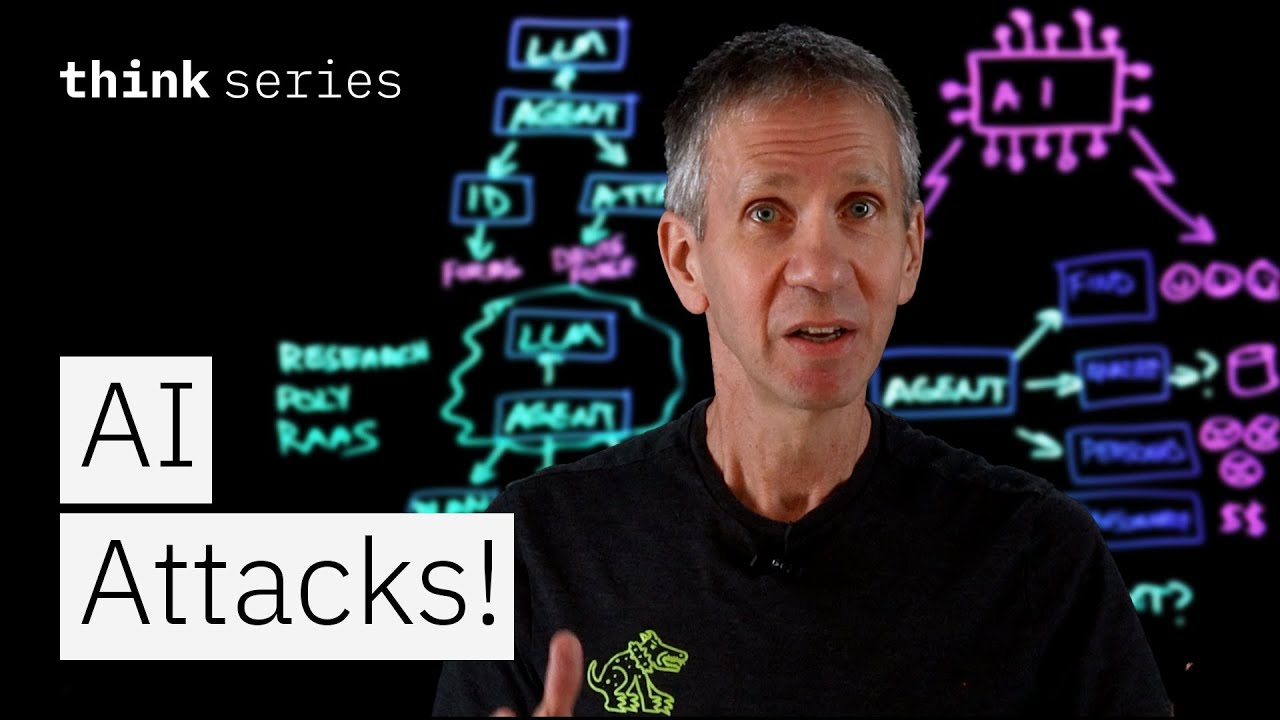
TL;DR: This article explores how cybercriminals are weaponizing artificial intelligence to launch sophisticated, automated attacks—including deepfake fraud, AI-generated ransomware, and credential cracking—lowering the technical barrier for attackers and increasing the scale and adaptability of threats.
📋 Table of Contents
Jump to any section (15 sections available)
📹 Watch the Complete Video Tutorial
📺 Title: AI ATTACKS! How Hackers Weaponize Artificial Intelligence
⏱️ Duration: 1116
👤 Channel: IBM Technology
🎯 Topic: Attacks Hackers Weaponize
💡 This comprehensive article is based on the tutorial above. Watch the video for visual demonstrations and detailed explanations.
Artificial intelligence is revolutionizing industries, enhancing customer service, and accelerating innovation—but it’s also empowering cybercriminals like never before. What once sounded like science fiction—AI-powered attacks—is now a harsh reality. From automated login break-ins to deepfake fraud and AI-generated ransomware, malicious actors are leveraging generative AI to launch sophisticated, scalable, and highly effective cyberattacks.
This comprehensive guide dives deep into the six most dangerous types of AI-powered threats emerging today. Based on real-world research, documented incidents, and cutting-edge security experiments, we’ll unpack exactly how hackers weaponize AI, the tools they use, and—most critically—what defenders must do to stay ahead. If you’re responsible for cybersecurity, business continuity, or data protection, this isn’t just informative—it’s essential.
Why AI-Powered Attacks Are a Game-Changer for Cybersecurity
Traditionally, executing a complex cyberattack required elite technical skills: coding expertise, deep knowledge of system vulnerabilities, and the ability to bypass security controls. But AI is dramatically lowering that barrier. Now, attackers can simply prompt an AI agent to plan, execute, and adapt an entire attack campaign—often with minimal human intervention.
The result? A surge in automated, intelligent, and polymorphic threats that evolve in real time, bypass traditional defenses, and mimic legitimate behavior with uncanny accuracy. As the transcript emphasizes: “We’re making the skill level that is required for an attacker be much lower… all they have to do is basically be like a vibe coder who’s doing vibe attacking.”
This shift means defenders can no longer rely on legacy tools alone. AI-powered offense demands AI-powered defense.
1. AI-Powered Login Attacks: BruteForceAI in Action
One of the first lines of defense for any system is its authentication mechanism. But AI is now being used to systematically test—and break—these safeguards.
How BruteForceAI Works
BruteForceAI is an AI-driven penetration testing framework that can be used ethically by security teams—or maliciously by hackers—to compromise login systems. It operates using an autonomous AI agent powered by a Large Language Model (LLM).
The attack unfolds in two key phases:
- Reconnaissance: The AI agent scans websites to identify login pages. It sends page HTML to an LLM, which parses the content and detects login forms with 95% accuracy.
- Attack Execution: Once a login form is identified, the agent launches one of two strategies:
- Brute Force Attack: Tries every possible username/password combination. Often ineffective due to account lockouts after 3 failed attempts.
- Password Spraying: Uses a single common password (e.g., “Password123”) across many usernames to avoid triggering lockout policies.
Critically, the entire process is automated. The attacker only needs to initiate the framework—the AI handles target identification, form parsing, and attack orchestration.
2. AI-Generated Ransomware: Prompt Lock and Ransomware-as-a-Service
Ransomware is evolving from static malware into an AI-driven, adaptive threat. A research project called Prompt Lock demonstrates how AI can orchestrate an entire ransomware campaign—from target selection to ransom negotiation.
The AI Ransomware Kill Chain
Prompt Lock uses an AI agent coupled with an LLM to execute a multi-stage attack:
| Stage | AI-Powered Action |
|---|---|
| Target Analysis | Scans systems to identify high-value files (e.g., financial records, intellectual property) and ignores low-value data. |
| Attack Customization | Dynamically sets ransom demands based on the perceived value of stolen data. |
| Malware Generation | Writes and deploys custom encryption code to lock victim files. |
| Ransom Note Creation | Generates a personalized, grammatically perfect message listing stolen files and payment instructions. |
| Polymorphic Behavior | Each attack instance is unique—evading signature-based detection systems. |
Even more alarming: Prompt Lock runs in the cloud, enabling Ransomware-as-a-Service (RaaS) powered entirely by AI. This means even non-technical criminals can deploy sophisticated ransomware with a few clicks.
3. AI-Powered Phishing: The End of “Bad Grammar” as a Red Flag
For years, cybersecurity training taught users to spot phishing emails by looking for poor grammar, spelling errors, or awkward phrasing. But AI has rendered this advice obsolete.
How AI Transforms Phishing
Attackers now use unrestricted LLMs (often found on the dark web) to generate flawless, context-aware phishing content in any language—even if the attacker doesn’t speak it. As the transcript notes: “The smart phishers will… use an LLM… which will generate their text in perfect English or Spanish or French.”
Moreover, AI enables hyper-personalization:
- Scrapes social media to gather personal details (e.g., recent vacations, job titles, family members).
- Crafts messages that reference specific events or relationships, increasing credibility.
- Generates convincing sender names, subject lines, and body copy in seconds.
IBM’s Eye-Opening Experiment
An IBM study compared AI-generated phishing emails to human-crafted ones:
| Metric | AI-Generated Phishing | Human-Crafted Phishing |
|---|---|---|
| Time to Create | 5 minutes | 16 hours |
| Effectiveness | Almost equal to human version | Slightly more effective |
| Scalability | Can generate thousands instantly | Limited by human capacity |
Given AI’s rapid improvement trajectory, it’s only a matter of time before it surpasses human phishing quality—while remaining exponentially faster and cheaper.
4. AI-Powered Fraud: The Deepfake Threat Is Real and Costly
Generative AI has made deepfakes—realistic audio and video forgeries—accessible, convincing, and dangerously effective for financial fraud.
How Deepfakes Work
An attacker feeds a short sample of your voice or video into a generative AI model. The model learns your speech patterns, facial expressions, and mannerisms. Then, by inputting a script, the attacker can make you “say” or “do” anything.
Shockingly, some models require only 3 seconds of audio to create a believable voice clone. As the transcript warns: “If you think that by not leaving your voice on your voicemail, it’s going to protect you… think again.”
Real-World Deepfake Fraud Cases
These aren’t hypotheticals—they’ve already cost companies tens of millions:
| Year | Attack Type | Impact |
|---|---|---|
| 2021 | Audio deepfake impersonating a CEO | Employee wired $35 million to attacker’s account |
| 2024 | Video deepfake of CFO in a live call | Employee transferred $25 million before realizing the fraud |
The lesson is clear: “If you aren’t in the room, you can’t believe it.” Visual and auditory confirmation is no longer sufficient proof of identity.
5. AI-Powered Exploits: CVE Genie Automates Hacking
Vulnerabilities are cataloged publicly via CVEs (Common Vulnerabilities and Exposures)—a system meant to help defenders patch flaws. But attackers are now using AI to turn these same reports into ready-to-deploy exploits.
Meet CVE Genie
CVE Genie is an AI agent that automates exploit development:
- Takes a CVE report as input.
- Feeds it to an LLM, which extracts technical details about the vulnerability.
- The AI agent interprets how to weaponize the flaw.
- Generates functional exploit code automatically.
In testing, CVE Genie achieved a 51% success rate in generating working exploits—and each attempt cost less than $3.
Implications for Malware Development
This same approach can create polymorphic malware that:
- Obfuscates its code to evade detection.
- Adapts behavior based on the target environment.
- Exploits zero-day or recently disclosed vulnerabilities faster than patches can be deployed.
Now, even script kiddies with no coding knowledge can launch advanced attacks using publicly available vulnerability data and cheap AI tools.
6. Full AI Kill Chain: Autonomous End-to-End Attacks
The most advanced threat combines all the above techniques into a single, autonomous system that runs the entire cyber kill chain—from reconnaissance to exfiltration to extortion.
Weaponized AI Agents in Practice
Researchers have already demonstrated AI systems (e.g., one weaponizing Anthropic’s models) that can:
- Identify high-value targets based on data exposure and financial capacity.
- Exfiltrate and analyze stolen data to determine its ransom value.
- Create fake personas for extortion communications, shielding the attacker’s identity.
- Calibrate ransom demands using economic logic: “If you ask for too much, they won’t pay. Too little, you sold yourself short.”
- Generate and deploy custom ransomware tailored to the victim.
This represents the ultimate “vibe hacking” scenario: the attacker provides high-level intent (“steal valuable data and get paid”), and the AI handles every technical detail.
The Rising Threat of Polymorphic AI Attacks
A recurring theme across all these attack types is polymorphism—the ability of malware or attack code to change its appearance with each use. Traditional antivirus and intrusion detection systems rely on known signatures, but AI-generated attacks are unique every time.
As the transcript states: “We could see polymorphic generated ransomware attacks coming from AI.” This makes detection exponentially harder and increases the success rate of each campaign.
Economic Incentives Driving AI Weaponization
The economics favor attackers dramatically:
- Low cost: Exploits for under $3; phishing emails in 5 minutes.
- High ROI: Single deepfake fraud can net $25M+.
- Scalability: One AI agent can run thousands of concurrent attacks.
- Accessibility: No coding skills required—just prompt engineering.
This imbalance is accelerating adoption among cybercriminals and organized crime syndicates.
Defensive Imperatives: Good AI vs. Bad AI
The transcript delivers a clear verdict: “We’re going to need to leverage AI for cyber defense to do prevention, detection and response. It won’t be optional. It’s going to be good AI versus bad AI.”
What Defenders Must Do Now
- Deploy AI-Powered Security Tools: Use defensive AI for anomaly detection, behavioral analysis, and automated threat response.
- Retrain Users: Update phishing awareness training to focus on request verification—not grammar checks.
- Implement Multi-Factor Authentication (MFA): Especially phishing-resistant MFA (e.g., FIDO2 keys) to block credential theft.
- Adopt Zero Trust Architecture: Assume breach; verify every access request.
- Monitor for Deepfake Indicators: Use AI tools that detect synthetic media in video/audio calls.
- Patch Rapidly: Reduce the window between CVE disclosure and patching—AI attackers move fast.
Future Outlook: The AI Arms Race Has Begun
We are only at the beginning of the AI cyber arms race. As AI models grow more capable, so will the sophistication of attacks. Future threats may include:
- AI agents that negotiate ransoms in real time.
- Autonomous botnets that adapt to network defenses.
- AI-generated fake evidence to frame individuals or organizations.
But defenders have a path forward—if they act now.
Key Takeaways: Actionable Insights from the Transcript
- AI is lowering the skill barrier for cybercrime—“vibe hacking” is real.
- BruteForceAI can find and attack login pages with 95% accuracy.
- Prompt Lock enables AI-driven ransomware with personalized ransom notes.
- Perfect grammar in phishing emails is now a norm, not a red flag.
- Deepfakes can be created from just 3 seconds of audio—and have already stolen $60M+.
- CVE Genie turns public vulnerability reports into exploits for under $3.
- Autonomous AI agents can run the entire kill chain without human intervention.
- Defense must be AI-powered: “Good AI versus bad AI” is the new reality.
Resources Mentioned in the Transcript
- BruteForceAI: AI-powered login attack framework.
- Prompt Lock: Research project on AI-generated ransomware.
- CVE Genie: AI system that auto-generates exploits from CVE reports.
- IBM Phishing Experiment: Compared AI vs. human phishing effectiveness.
- Anthropic-based Weaponized AI: Demonstrated full AI kill chain execution.
Final Warning: This Is Just the Beginning
The transcript concludes with urgency: “AI attacks are not going to get worse”—implying they’re already here and escalating. But there’s hope. By embracing defensive AI, updating policies, and retraining teams, organizations can turn the tide.
The battle is no longer just about firewalls and passwords. It’s about intelligence versus intelligence. And as the video insists: “Make sure the good one wins.”