
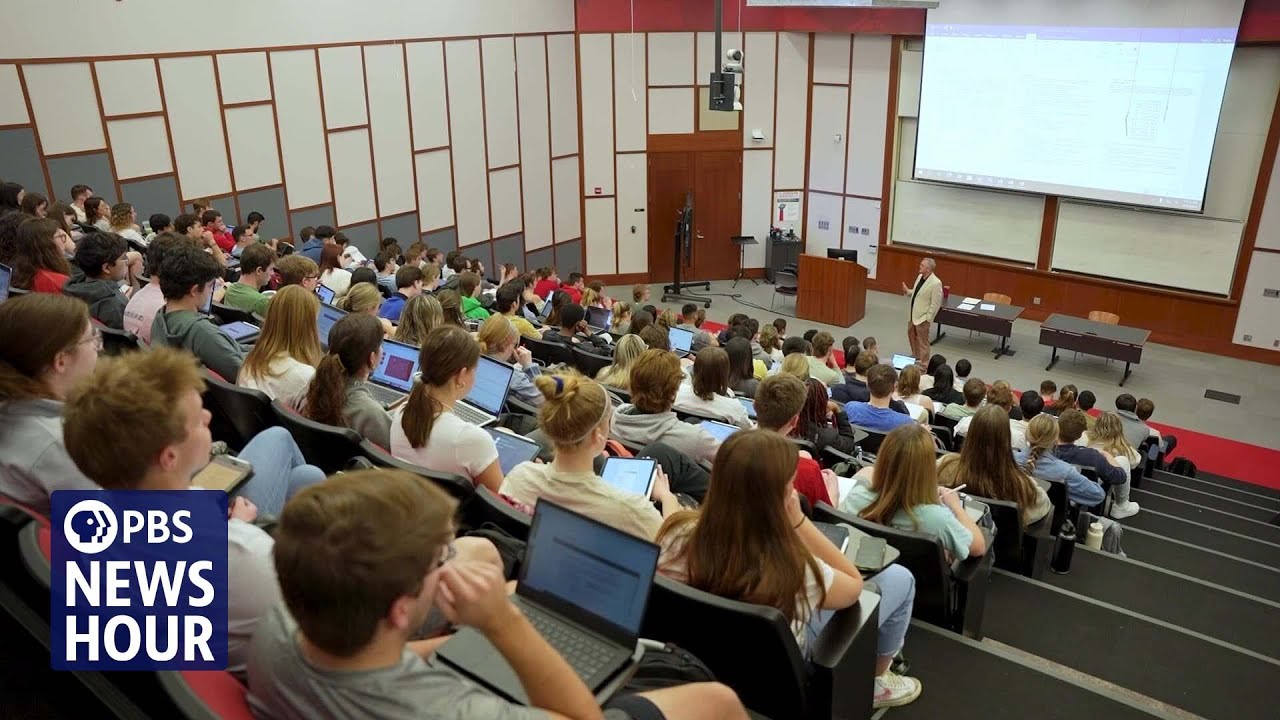
TL;DR: This article explores how generative artificial intelligence tools like ChatGPT, Claude AI, and Google Gemini are transforming higher education, affecting how students learn, professors teach, and institutions approach academic integrity.
📋 Table of Contents
Jump to any section (16 sections available)
📹 Watch the Complete Video Tutorial
📺 Title: How artificial intelligence is reshaping college for students and professors
⏱️ Duration: 597
👤 Channel: PBS NewsHour
🎯 Topic: Artificial Intelligence Reshaping
💡 This comprehensive article is based on the tutorial above. Watch the video for visual demonstrations and detailed explanations.
The class of 2024 marks a historic milestone: it’s the first senior cohort at universities nationwide to have spent nearly their entire college experience in the age of generative artificial intelligence. This transformative technology—capable of creating human-like text, images, and even code—is no longer a futuristic concept. It’s embedded in daily academic life, reshaping how students learn, how professors teach, and how institutions define academic integrity. From detection dilemmas to innovative classroom integration, generative AI is forcing a complete rethinking of higher education.
In this comprehensive guide, we unpack every insight, real-world example, policy shift, and student-professor perspective from PBS NewsHour’s in-depth report on how Artificial Intelligence Reshaping college campuses across America. No detail is left out—from detection software struggles to Ohio State’s bold AI fluency initiative.
The Turning Point: When Professors First Noticed AI in Student Work
About two years ago, Megan Fritts, a philosophy professor at the University of Arkansas at Little Rock, began spotting something unusual in her students’ assignments. Suddenly, essays and test answers from students whose writing she knew well started sounding like “official business documents” or “technical writing”—highly polished but deeply impersonal.
Fritts realized: this wasn’t her students’ authentic voice. It was likely AI-generated content. This moment marked the beginning of a seismic shift across higher education, as generative AI swept through campuses nationwide.
Why Generative AI Spread So Rapidly in Academia
The appeal is obvious: tasks that once required hours or even days of writing and revision can now be completed in mere minutes. For example, a student can prompt ChatGPT: “Write me a 1000-word essay on the topic of, ‘Is it OK to lie?’” Using vast training data, the AI instantly predicts and generates coherent, structured prose.
But for educators like Fritts, this convenience comes at a steep cost. “If I’m reading the writings of ChatGPT instead of my students,” she says, “I have lost the very best tool that I have to see if I am being effective in my capacity as an instructor.”
Academic Integrity in Crisis: The Detection Dilemma
Universities are scrambling to respond. Brian Berry, Vice Provost of Research at UA Little Rock, leads a campus committee tasked with crafting AI policies. He acknowledges a sobering reality: “The technology is outpacing our ability to detect it.”
How One Professor Detects AI Use
Professor Fritts enforces a strict no-AI policy in her classroom. When she suspects AI use, her process is rigorous:
- She runs the submission through Phrasely, one of eight different AI detection softwares she uses.
- If multiple tools flag the text as AI-generated, she meets with the student.
- During the meeting, she asks the student to explain or discuss the content of their assignment.
“If they can talk about the thing that they wrote about, then great,” Fritts says. “But a lot of times, they can’t.”
The Flaws in AI Detection Tools
Detection software is far from foolproof. False positives are common, and students report being penalized for writing styles that happen to resemble AI output.
Ashley Dunn, a former senior at Louisiana State University, was accused of using AI to write a short essay for a British literature class after a detection tool flagged her work. “I was like, am I gonna fail this class? Am I gonna get a zero?” she recalls, noting that colleges treat plagiarism very seriously.
Though Dunn was eventually given an A for the assignment after clarifying with her professor, her TikTok video about the incident went viral—with countless students sharing similar stories of being falsely accused.
“A lot of people ended up making responses to my video… saying that they had gone through the same thing, but that they didn’t really get as lucky and they ended up either getting zeros or failing the class. Some people recently have been making videos about, ‘Oh, my professor said that my essay was AI because I used an em dash’—but that’s just a regular way of writing, especially for a college level.”
Two Campus Responses: Restriction vs. Integration
Not all universities are taking a hardline stance against AI. In fact, institutions are diverging sharply in their approaches—some banning it, others embracing it as an educational tool.
Policy Approach at UA Little Rock
UA Little Rock is finalizing a campus-wide policy that gives individual professors the authority to decide what AI use is acceptable in their courses—as long as it’s clearly outlined in the syllabus. This decentralized model empowers faculty while promoting transparency.
Ohio State’s Proactive Integration Strategy
Meanwhile, Ohio State University has taken a radically different path. Rather than resist AI, it’s embedding it into the core curriculum.
Ravi Bellamkonda, Executive Vice President and Provost at Ohio State, was struck by a student AI violation case that made him rethink the technology’s potential. “What if there existed technology that indeed lets our students produce work of very high quality? Shouldn’t we investigate this a little further?”
His answer: launch the AI Fluency Initiative—a university-wide program requiring all undergraduate students across all disciplines to learn and use AI tools responsibly.
“The trick is to figure out, like any human interaction with technology, what can we offload to technology, and what do we need to add value to? Ohio State wants to be at the front of that creation of those rules.”
Real-World Classroom Applications of Generative AI
At Ohio State, AI isn’t just permitted—it’s encouraged as a learning aid. Professors and students are experimenting with innovative, discipline-specific uses.
Entrepreneurship: AI as a Critical Thinking Partner
Lori Kendall, who teaches entrepreneurship at Ohio State’s Fisher College of Business, initially asked, “Now what? Do we allow AI? Do we not allow AI?” But she quickly realized: “They’re going to use it anyway.”
Now, she encourages students to use AI to critically examine their original work. As student Rachel Gervais (majoring in air transportation) explains: “I oftentimes use AI to create questions regarding this topic. So I not only get a better understanding of the actual material, but I also can test and see what I need to maybe focus on even more.”
Kendall emphasizes: “A lot of people might use AI just to get assignments done or [commit] plagiarism, but I like to use AI for deeper understanding.”
Music: AI as a Research and Teaching Accelerator
In the College of Arts and Sciences, Professor Tina Tallon teaches a course titled “AI and Music.” Her pedagogical approach starts not with technology, but with problems.
“I always start the class by asking them to think about a challenge in their field. At that point, we’re not even talking about AI. I just want them to identify something that either they’ve run up against or that their students or their colleagues have.”
Case Study: Tuba Performance Optimization
Doctoral student and tuba instructor Will Roesch is using AI to analyze airflow into his instrument across thousands of repetitions. The resulting data helps him guide students toward playing the “perfect note”—a task previously impossible due to the sheer volume of manual analysis required.
Case Study: Infant Musical Development Research
Graduate student Natalia Moreno Buitrago studies how babies acquire musical knowledge. Before AI, she spent hours combing through home audio recordings, manually identifying moments when caregivers sang or hummed near infants.
Now, AI automates this process—freeing her to focus on analysis and interpretation rather than data collection.
“If we critically examine the tools that we’re engaging with and are actively involved in the development of them, I think we can do some pretty incredible things.”
The Broader Implications: Beyond the Classroom
The disruption caused by generative AI extends far beyond academic assignments. It’s reshaping the very skills students need to succeed in a rapidly evolving job market.
“If you don’t use AI or the next technology that comes along to be effective, you’re not going to be competitive in the job market. The job market’s changing right under your feet.”
This reality forces a fundamental question: how can institutions navigate this transformative moment in a way that ultimately improves human potential rather than diminishes it?
“How do we go through a transformative moment like this with the disruptions that it is going to cause and yet do this in a way that ultimately is additive to us as a society? That it improves our lot as human beings?”
Student Perspectives: Caught in the Middle
Students are navigating a confusing, inconsistent landscape. While some professors ban AI outright, others require its use. Detection tools are unreliable, and penalties can be severe—even for honest mistakes.
Ashley Dunn’s experience highlights the emotional toll: anxiety, fear of academic penalties, and frustration with opaque systems. Yet others, like Rachel Gervais, see AI as a legitimate study partner that enhances—not replaces—learning.
Faculty Challenges: From Teaching to Policing
Professors like Megan Fritts are bearing the brunt of enforcement. Verifying AI use is time-consuming, technically complex, and emotionally draining.
Using eight different detection softwares—including Phrasely—is not sustainable long-term. And even when AI is confirmed, confronting students feels less like education and more like surveillance.
Policy Frameworks: What Universities Are Doing Now
Higher education institutions are developing varied policy responses:
| Institution | AI Policy Approach | Key Features |
|---|---|---|
| University of Arkansas at Little Rock | Decentralized, faculty-driven | Professors set AI rules per course; must be stated in syllabus. Detection and enforcement left to individual instructors. |
| Ohio State University | University-wide integration | AI Fluency Initiative mandates AI literacy for all undergraduates. Encourages critical, creative use across disciplines. |
| Many other institutions | Reactive or undefined | No clear policy; reliance on honor codes and existing plagiarism frameworks, which weren’t designed for AI. |
The Ethical Core: Revisiting Kant in the Age of AI
Philosophy professor Megan Fritts opens her classes with Immanuel Kant’s principle: “Treat all people as ends in themselves, never merely as means.” This ethical foundation takes on new meaning in the AI era.
When students outsource thinking to AI without engagement, they risk becoming mere conduits for machine output—violating the very purpose of education: human development, critical thought, and authentic expression.
AI Tools Mentioned in Campus Use
Students and faculty are actively using a range of generative AI platforms:
- ChatGPT – Used for essay drafting, question generation, and idea exploration.
- Claude AI – Cited in the 86% usage statistic; known for nuanced, long-form responses.
- Google Gemini – Integrated into Google Workspace; accessible via common student tools.
Detection Software Landscape
Despite limitations, detection tools are widely used. Professor Fritts alone employs eight different softwares, including:
- Phrasely – Specifically named as a first-line detection tool.
- Other unnamed AI detectors – Reflecting the fragmented, competitive market of detection technology.
Steps for Students: Using AI Responsibly
Based on insights from Ohio State and forward-thinking educators, here’s how students can ethically leverage AI:
- Use AI for understanding, not submission – Generate practice questions, clarify concepts, or brainstorm ideas.
- Always engage critically – Don’t accept AI output at face value; interrogate its logic and sources.
- Disclose usage when required – Follow your professor’s syllabus guidelines.
- Test your own knowledge – Use AI-generated quizzes to identify gaps in your learning.
Steps for Professors: Designing AI-Resilient Assignments
Educators can reduce AI misuse by redesigning assessments:
- Incorporate personal reflection or in-class writing.
- Require oral defenses or process documentation.
- Focus on local, current, or unique prompts that AI hasn’t been trained on.
- Clarify AI policies in writing on the syllabus.
The Future: Co-Creating the Rules with Students
As Ravi Bellamkonda suggests, the path forward isn’t top-down prohibition—it’s collaborative innovation. Students must be active participants in shaping how AI is used in education.
After all, they are the generation entering a workforce where AI fluency is no longer optional. Higher education’s role isn’t to shield them from this reality—but to prepare them to harness it ethically and effectively.
Conclusion: Navigating the AI Transformation Together
Generative AI is not a passing trend. It’s a foundational shift in how knowledge is created, shared, and evaluated. The class of 2024 stands at the epicenter of this transformation—learning in real time how to balance convenience with integrity, innovation with ethics.
From Megan Fritts’ detection struggles to Natalia Moreno Buitrago’s research breakthroughs, the message is clear: Artificial Intelligence Reshaping higher education isn’t about banning or blindly adopting tools. It’s about cultivating critical engagement, transparent policies, and human-centered learning.
As Fred de Sam Lazaro reports from Columbus, Ohio: this is a question without a clear answer yet. But with thoughtful collaboration between students, faculty, and institutions, the disruption of AI can become a catalyst for a more dynamic, relevant, and human-centered higher education.