TL;DR: The article examines the massive AI-driven financial bubble inflating the U.
📋 Table of Contents
Jump to any section (18 sections available)
📹 Watch the Complete Video Tutorial
📺 Title: AI bubble madness: Why the stock market fell $2,000,000,000,000 in just FIVE HOURS
⏱️ Duration: 1705
👤 Channel: Geopolitical Economy Report
🎯 Topic: Bubble Madness Why
💡 This comprehensive article is based on the tutorial above. Watch the video for visual demonstrations and detailed explanations.
The U.S. stock market is currently riding the largest financial bubble in history—one fueled almost entirely by artificial intelligence (AI) hype. At the center of this speculative frenzy stands Nvidia, the only major AI player actually turning a profit, thanks to its near-monopoly on advanced AI chips. But beneath the surface of soaring stock prices and trillion-dollar valuations lies a fragile house of cards built on circular financing, unsustainable debt, and blind faith that “the line will always go up.” This article unpacks the full scope of the AI bubble, its economic dependencies, geopolitical vulnerabilities, and the terrifying volatility that signals an inevitable crash.
The AI Bubble: Propping Up a Stagnant U.S. Economy
Contrary to mainstream narratives, the U.S. economy is not thriving—it’s being artificially sustained by AI-driven capital expenditure. Without this bubble, the nation would likely already be in recession. According to Harvard economist Jason Furman, former top economic adviser to President Barack Obama, 92% of U.S. GDP growth in the first half of 2025 came from investment in information processing equipment and software—primarily AI infrastructure. Strip that away, and GDP growth would have been a mere 0.1%, effectively economic stagnation.
This dependency reveals a critical truth: the AI bubble isn’t just a market anomaly—it’s the foundation of current U.S. economic performance. The government, aware of this fragility, has been actively pouring resources into Silicon Valley to delay the bubble’s inevitable pop.
The Magnificent 7: Controlling Over One-Third of the S&P 500
The entire U.S. stock market is now dominated by just seven tech giants, collectively known as the “Magnificent 7” (MAG7):
- Amazon
- Apple
- Alphabet (Google)
- Meta (Facebook)
- Microsoft
- Nvidia
- Tesla
As of November 17, 2025, these seven companies accounted for more than 35% of the S&P 500—the benchmark index of America’s 500 largest public companies. Their combined market capitalization exceeds the entire stock markets of Europe and China—despite China having 1.4 billion people and being the world’s largest economy by purchasing power parity.
Nvidia: The Only AI Company Actually Making Money
While most big tech firms pour billions into AI development, only Nvidia is generating real profits from AI. Its success stems from a global monopoly on the design of the most advanced GPUs (graphics processing units) essential for training large language models (LLMs) and other AI systems.
Nvidia’s founder and CEO, Jensen Huang, has become a financial celebrity, hailed as a visionary. Memes jokingly claim Nvidia is “holding up the entire global economy”—a statement that’s “not that much of a joke,” given the company’s outsized role.
In 2025, Nvidia became the first company in history to surpass a $4 trillion market capitalization, briefly touching $5 trillion before crashing back down.
Volatility as Proof of Bubble Mania
Nvidia’s stock exhibits extreme, irrational swings that defy fundamental analysis—classic bubble behavior:
- On November 19, 2025, after reporting strong earnings, Nvidia’s market cap surged by $450 billion in just a few hours.
- Within 24 hours, it then plummeted by $600 billion in a single day.
- Over a 54-hour period, the company experienced a $1 trillion swing in market value—equivalent to $19 billion per hour.
The Cobusy Letter, a respected financial newsletter, called this “absolute insanity,” noting these moves are driven by sentiment, not fundamentals—a hallmark of speculative mania.
Circular Financing: The Illusion of Profitability
A key mechanism sustaining the bubble is circular financing: big tech companies invest in each other to create the illusion of growth, even as they hemorrhage cash.
The OpenAI Case Study
OpenAI, despite being a private company, exemplifies this unsustainable model:
- Microsoft (a major OpenAI investor and public company) revealed that OpenAI lost $12 billion in a single quarter.
- OpenAI has $1.4 trillion in future commitments for Nvidia chips and data centers (e.g., from Oracle)—but lacks the funds to pay them.
- CEO Sam Altman claims profitability is “just a few years away,” but analysts say “the numbers don’t add up.”
Nvidia, in turn, reinvests some of its AI chip revenue into companies like OpenAI—its own customers—effectively propping up buyers who can’t afford its products long-term.
Red Flags in Nvidia’s Earnings Report
Despite glowing headlines about Nvidia’s Q3 FY2025–2026 earnings, financial analysts uncovered three major red flags:
1. Extreme Customer Concentration
Just four unnamed customers account for 61% of Nvidia’s revenue:
| Customer | Revenue Share |
|---|---|
| Customer A | 22% |
| Customer B | 15% |
| Customer C | 13% |
| Customer D | 11% |
These are widely believed to be Meta, Alphabet, OpenAI, and possibly Tesla, XAI, or Oracle. If any reduce AI spending—due to mounting losses—Nvidia’s revenue could collapse.
2. Soaring Accounts Receivable
Nvidia’s accounts receivable (sales made on credit) is rising sharply. This means customers like OpenAI are buying chips without immediate payment, banking on future funding. But with investor skepticism growing, many may never pay their bills—turning receivables into bad debt.
3. Exploding Inventory Levels
Despite claims of “insatiable demand,” Nvidia’s inventory has tripled in one year, reaching $20 billion by Q3 FY2025–2026. If demand were truly unmet, inventory wouldn’t accumulate—it would sell out instantly. This suggests overproduction or slowing orders.
Jensen Huang’s Public vs. Private Messaging
Publicly, Huang dismisses bubble concerns. After the Q3 earnings report, he told critics: “We see something very different,” implying AI growth is real and lasting.
But a leaked internal audio recording tells a different story. In a private Nvidia meeting, Huang admitted:
“Most people have concluded that this is a bubble… We’re in a no-win situation. If we deliver a bad quarter, it’s evidence there’s an AI bubble. If we deliver a great quarter, we are fueling the AI bubble.”
He even joked about Nvidia “basically holding the planet together—and it’s not untrue,” and quipped about losing “$500 billion in a few weeks”—a feat only possible with a $5 trillion valuation.
Geopolitical Threats to Nvidia’s Monopoly
Investors assume Nvidia’s dominance is unassailable—but that’s dangerously naive. China is aggressively challenging U.S. chip supremacy:
- Huawei is already producing advanced AI chips.
- Alibaba, Baidu, and numerous lesser-known Chinese firms are racing to develop domestic GPU alternatives.
- The Chinese government has made semiconductor independence a top national priority.
Even within the U.S., companies like Google are developing in-house AI accelerators to reduce reliance on Nvidia. The idea of a permanent “moat” is a fantasy.
Market-Wide Contagion Risk
Nvidia’s volatility doesn’t occur in isolation. When its stock crashed by $600 billion in one day, panic spread across the entire market:
| Company | Stock Drop from Peak |
|---|---|
| Oracle | 44% |
| Palantir | 30% |
| Meta | 27% |
| AMD | 27% |
| Tesla | 22% |
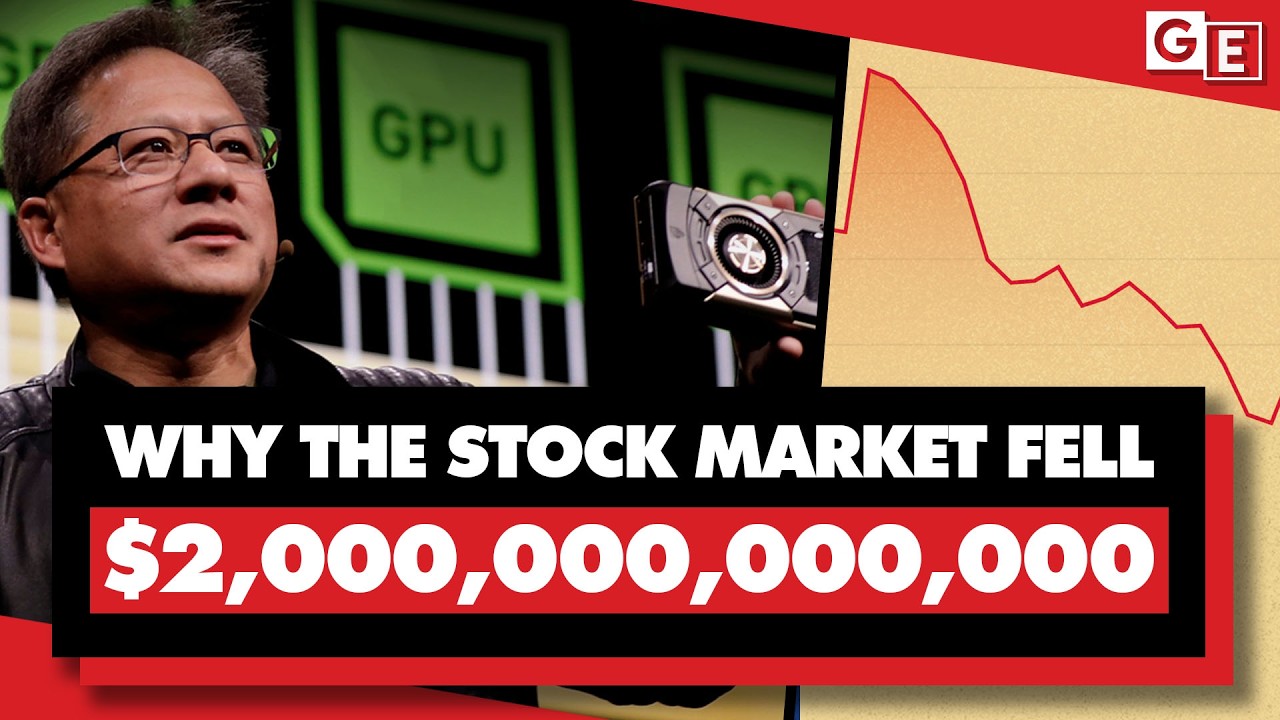
The S&P 500 lost $2 trillion in just five hours—the worst reversal since the “Liberation Day” tariff panic under Trump in April 2025.
Absurd Valuation Targets: $20 Trillion by 2030?
The mania has reached delusional levels. One U.S. finance professional publicly raised her 2030 Nvidia market cap target from $10 trillion to $20 trillion—a quintupling in five years from its current $4 trillion.
To put this in perspective: the IMF projects U.S. GDP in 2030 will be $36.8 trillion. A single company would be worth over half the entire annual output of the U.S. economy. While economists caution against comparing GDP (a flow) to market cap (a stock), the sheer scale reveals a collective loss of rationality.
Historical Parallels: From Dot-Com to Great Depression
This isn’t the first bubble—but it may be the largest. The dot-com bubble of 2000 saw similar “this time is different” thinking. Even further back, the 1920s stock boom was hailed as a “Golden Age” until the 1929 crash triggered the Great Depression and, ultimately, World War II.
As economist John Maynard Keynes famously warned: “Markets can remain irrational longer than you can remain solvent.” The bubble may inflate longer than expected—but it will pop.
Why the Bubble Might Pop Sooner Than Expected
Several catalysts could accelerate the collapse:
- Customer insolvency: If OpenAI or other major buyers default on chip payments.
- Geopolitical disruption: U.S.-China tech decoupling or export controls backfiring.
- Investor fatigue: As red flags multiply, even bullish funds may retreat.
Inventory glut: Unsold GPUs flooding the market as demand slows.
The Global Financialization Time Bomb
The AI bubble is just one piece of a larger, dangerous trend: the financialization of the global economy. Since the 1980s–90s deregulation era, economies have become dependent on inflating bubbles in:
- U.S. equities
- Cryptocurrencies
- Real estate
- Private credit and equity
When the AI bubble bursts, it won’t just affect tech—it could trigger a global recession or even depression, given how deeply interconnected financial markets have become.
What Happens When the Bubble Pops?
The consequences could be catastrophic:
- Massive wealth destruction: Trillions in paper gains vanish overnight.
- Corporate bankruptcies: Over-leveraged AI firms like OpenAI collapse.
- Job losses: Tech layoffs spread to supporting industries.
- Social unrest: As unemployment rises and inequality deepens.
And despite promises of AI-driven utopia, the reality may be mass job displacement without social safety nets—leaving billions unable to participate in the very economy AI was supposed to enhance.
Can the Bubble Keep Inflating?
Yes—for a while. Bubbles often grow more irrational as they expand, with participants doubling down despite clear warning signs. The U.S. government and Federal Reserve may intervene with liquidity or policy support to delay the reckoning.
But history is clear: all bubbles pop. The only questions are when and how hard.
What Investors and Citizens Should Watch
Monitor these key indicators for early signs of collapse:
- Nvidia’s quarterly customer concentration—if top clients reduce orders.
- Accounts receivable vs. revenue growth—divergence signals payment risk.
- Inventory turnover ratios—slowing sales despite high production.
- Chinese GPU advancements—any breakthrough could shatter Nvidia’s pricing power.
- OpenAI/Microsoft financial disclosures—further losses may trigger a sell-off.
Conclusion: The Madness Must End
The AI stock bubble is not a minor market quirk—it’s the central pillar of the modern U.S. economy, built on speculation, circular debt, and geopolitical fragility. Nvidia’s $4 trillion valuation, OpenAI’s $1.4 trillion in unpayable commitments, and the MAG7’s control over one-third of the S&P 500 all point to an unsustainable system hurtling toward a reckoning.
As mainstream outlets like Fortune warn of a “show me the money moment” for AI, the writing is on the wall. The bubble may inflate a bit longer, but when it bursts, the fallout could dwarf the 2008 financial crisis. The only responsible stance is to recognize the madness for what it is—and prepare for the inevitable correction.