TL;DR: Alibaba has quietly emerged as a global AI leader by building a comprehensive end-to-end ecosystem that includes foundational models, open-source tools, cloud infrastructure, and consumer applications.
📋 Table of Contents
Jump to any section (20 sections available)
📹 Watch the Complete Video Tutorial
📺 Title: How Alibaba Quietly Became a Leader in AI
⏱️ Duration: 529
👤 Channel: CNBC International
🎯 Topic: Alibaba Quietly Became
💡 This comprehensive article is based on the tutorial above. Watch the video for visual demonstrations and detailed explanations.
In a world racing toward artificial intelligence dominance, one tech giant has been executing a masterclass in strategic reinvention—Alibaba. While headlines often spotlight Western players like OpenAI or Microsoft, Alibaba has been quietly building an end-to-end AI ecosystem that spans foundational models, open-source innovation, cloud infrastructure, consumer applications, and global industry partnerships. This comprehensive guide unpacks exactly how Alibaba quietly became a serious contender in the global AI race—and why its approach may reshape the future of AI adoption worldwide.
Alibaba’s $53 Billion AI Bet: A Strategic Pivot for the Ages
In early 2025, Alibaba announced a massive wave of investment in AI and infrastructure—on top of the staggering $53 billion it had already pledged earlier that year. This move marked one of the boldest strategic bets in the company’s history. The investment wasn’t just about technology; it signaled a fundamental transformation in Alibaba’s identity.
As noted by veteran tech journalist Arjun Kharpal, “There has been a huge shift in what this company is about. Alibaba’s all in AI.” This pivot comes at a pivotal global moment when AI is universally recognized as the next technological frontier.
Why Alibaba’s AI Rise Has Been Under the Radar
Despite its scale and capabilities, Alibaba’s ascent in AI has received less fanfare than rivals like OpenAI or DeepSeek. Part of this stems from geographic and media bias—Western narratives often overlook Chinese innovation. However, that perception is shifting.
The emergence of Chinese AI players like DeepSeek has changed global perceptions. “We stopped seeing them as being the worse version of the western model,” Kharpal observes. Alibaba, with its 900+ million user base, is now firmly positioned as a key player in the global AI landscape—not just a regional one.
The Origins of Alibaba’s AI Journey: From 2016 to DAMO Academy
Alibaba’s AI ambitions didn’t begin overnight. The foundation was laid as early as 2016, when the company launched its first AI lab and began experimental projects.
Building Institutional AI Muscle: The DAMO Academy (2017–2018)
The strategy deepened in 2017 and 2018 with the creation of the DAMO Academy—Alibaba’s dedicated AI research institute. This move signaled a commitment to fundamental, long-term AI research rather than just applied products.
Acceleration During the Pandemic (2019–2021)
The real acceleration occurred during the COVID-19 years (2019–2021), when Alibaba began developing its own foundational models and even designing custom AI chips. This vertical integration gave the company greater control over its AI stack and reduced reliance on foreign hardware.
The ChatGPT Catalyst: How OpenAI Forced Alibaba’s Hand
The release of ChatGPT in late 2022 was a watershed moment. The app reached 1 million users in under a week, igniting the global AI race. For Alibaba, this was a wake-up call.
In direct response, Alibaba launched a world-class AI research lab and began backing AI startups with the explicit goal of creating “China’s answer to OpenAI.” This marked a shift from internal R&D to ecosystem-building and strategic investment.
Eddie Wu’s Leadership: The CEO Who Cemented Alibaba’s AI Future
In early 2024, Eddie Wu was appointed CEO—a move that solidified Alibaba’s AI-first direction. In his first letter to employees, Wu called for a return to the company’s “startup mindset” and established two core strategic pillars:
- User First
- AI-Driven
Under Wu’s leadership, Alibaba’s quarterly capital expenditure more than doubled
Qwen: Alibaba’s Open-Source LLM Family Powering Global Innovation
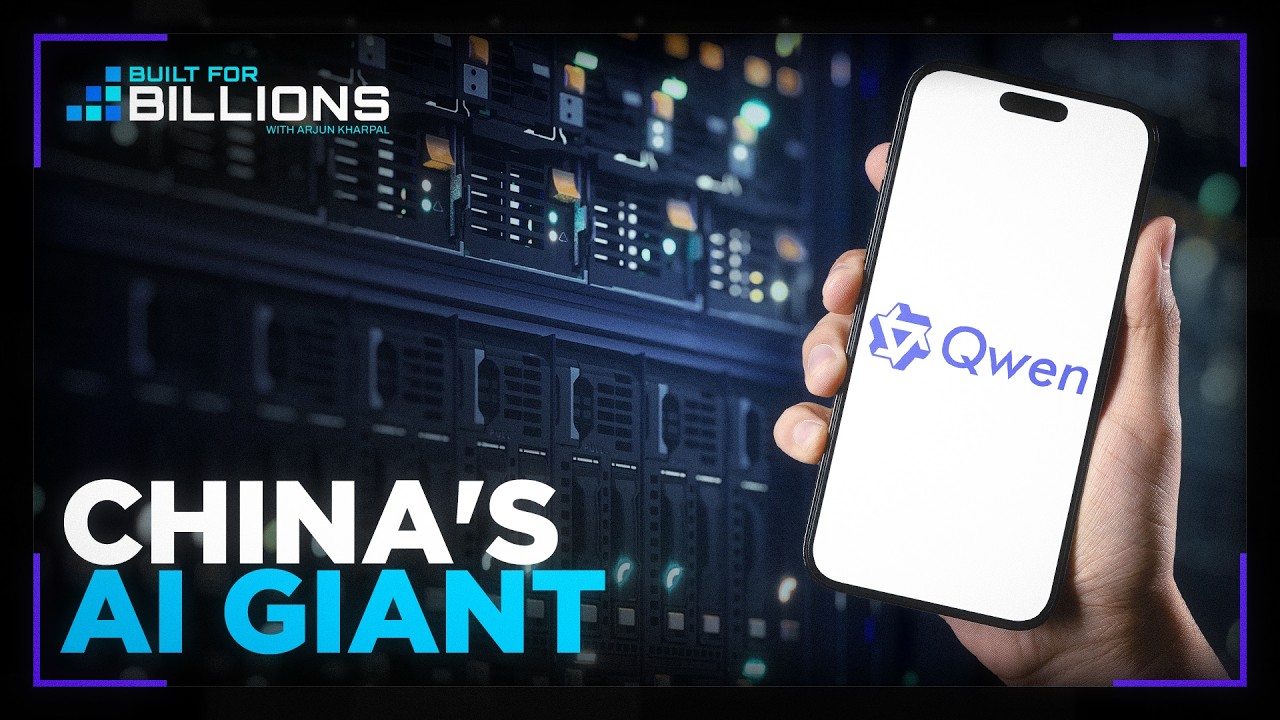
At the heart of Alibaba’s AI strategy is Qwen—its family of large language models capable of understanding text, answering questions, translating languages, and processing images. Qwen serves as Alibaba’s equivalent to the models underpinning OpenAI’s ChatGPT.
The Open-Source Advantage: China vs. the U.S.
Unlike most U.S. models, Qwen is open-source, allowing developers to modify, redistribute, and use it commercially—for free. This reflects a fundamental philosophical and strategic divergence:
| Region | Default Model Release Strategy | Business Model Implication | Ecosystem Impact |
|---|---|---|---|
| China | Open-source by default | Cannot monetize model access directly | Drives rapid adoption and ecosystem growth |
| United States | Closed models by default | Monetize via API access and subscriptions | Limited customization; centralized control |
Alibaba embraces open-source not as a limitation but as a growth engine. “You get a lot more adoption… there is a full ecosystem that grows around these kinds of models,” explains Kharpal.
The DeepSeek Moment: How Competition Spurred Alibaba’s Breakthrough
In early 2025, Chinese startup DeepSeek shocked the world with its R1 model—released strategically just 7–8 days before Chinese New Year, China’s largest holiday.
Alibaba’s response was immediate and intense: the Qwen team canceled their holiday, worked nonstop for eight days, and launched Qwen 2.5 by January 28, 2025—a model on par with DeepSeek’s offering.
This was followed in April 2025 by Qwen3, Alibaba’s most advanced model to date. This rapid iteration demonstrates Alibaba’s agility and commitment to staying at the cutting edge.
Quark: Alibaba’s AI Assistant with 150 Million Monthly Users
Qwen isn’t just a backend model—it powers real-world applications. Chief among them is Quark, Alibaba’s AI assistant app with nearly 150 million monthly active users.
Quark goes beyond simple chat. It offers an “AI toolbox” for business use and functions as an “operating system for life,” driven by smart AI algorithms. As Kharpal describes it: “You are ultimately speaking with an intelligent genie who helps you get stuff done.”
ModelScope: Alibaba’s AI App Store for Developers
Alibaba has built a thriving developer ecosystem through ModelScope—its open platform often described as an “AI app store.”
Key Features of ModelScope
- Hosts hundreds of pre-trained models
- Allows developers to customize and build upon existing models
- Eliminates the need to start AI integration from scratch
The platform has attracted 16 million developers who have built thousands of models on top of Alibaba’s infrastructure. This self-reinforcing loop validates Alibaba’s belief in open-source as a path to ecosystem dominance.
Aliyun: Transforming Alibaba Cloud into an AI Distribution Hub
Behind the scenes, Alibaba has re-engineered its cloud platform, Aliyun, into a full-fledged AI distribution engine. Businesses can now run Qwen and other models on Alibaba Cloud to power chatbots, analytics tools, and enterprise applications.
Alibaba is positioning Aliyun as a direct competitor to Amazon AWS and Microsoft Azure. While its model performance may align more closely with Amazon than OpenAI, Alibaba’s strength lies elsewhere.
“Model performance is not what makes a company successful in AI. It is about scale. It’s about adoption, and it’s about solving real problems. And this is where Chinese companies in general, but Alibaba in particular, is really, really good at.”
Financial Results: AI Investments Are Already Paying Off
Alibaba’s AI bet is yielding tangible returns. In August 2025, its Cloud Intelligence Group reported:
- 26% year-on-year revenue increase
- Triple-digit growth in AI-related projects for eight consecutive quarters
These figures align with broader market projections. A May 2025 Morgan Stanley report52% returns by 2030.
Strategic Partnerships: Validating Alibaba’s AI in Real Industries
Alibaba is moving beyond consumer apps into complex industrial domains through high-profile partnerships.
BMW: AI in Intelligent Vehicles
Alibaba has partnered with BMW to integrate Qwen LLMs into BMW’s intelligent vehicles, scheduled for launch in 2026. This represents a major validation of Qwen’s reliability and adaptability in safety-critical, real-time environments.
Apple: Bringing Alibaba AI to iPhones in China
A deal with Apple could bring Alibaba’s AI capabilities to iPhone users in China, potentially embedding Qwen into iOS features like Siri or productivity tools.
These partnerships serve dual purposes: they build deep industry expertise and ensure Alibaba secures a foothold in global tech ecosystems before competitors do.
Alibaba’s Ecosystem Play: Building AI Labs with Governments and Universities
Alibaba isn’t working in isolation. The company is actively collaborating with local governments and universities across China to establish multiple AI research labs. This public-private synergy accelerates innovation, talent development, and real-world deployment—key ingredients for long-term AI leadership.
The Global Cloud Challenge: Why Alibaba Is Doubling Down on AI
Expanding cloud services outside China remains difficult due to intense competition from AWS, Azure, and Google Cloud. Alibaba recognizes this—and is using AI as its wedge.
“I think Alibaba probably has to accelerate that part of the business, which exactly is why they’re investing so much money in AI,” notes Kharpal. AI differentiation could be the key to cracking international markets.
China’s 2030 AI Vision: Alibaba as a National Champion
China has set an ambitious goal to dominate the global AI race by 2030. In this national mission, Alibaba isn’t just a participant—it’s a central pillar. “Wherever you look, whatever you touch, where China is moving closer towards that vision… Alibaba is participating and being an important player,” says Kharpal.
Timeline of Alibaba’s AI Evolution
| Year | Milestone |
|---|---|
| 2016 | Launch of first AI lab and initial experiments |
| 2017–2018 | Founding of DAMO Academy for fundamental AI research |
| 2019–2021 | Development of foundational models and custom AI chips |
| Late 2022 | ChatGPT launch spurs Alibaba to accelerate AI efforts |
| Early 2024 | Eddie Wu becomes CEO; declares “AI-driven” as core strategy |
| 2025 (Early) | $53 billion AI investment announced; DeepSeek R1 released |
| Jan 28, 2025 | Qwen 2.5 launched in response to DeepSeek |
| April 2025 | Qwen3 released—most advanced model to date |
| August 2025 | Cloud Intelligence Group reports 26% YoY growth |
Key Takeaways: Why Alibaba’s AI Strategy Works
- Open-source as growth engine: Drives adoption, developer loyalty, and ecosystem expansion
- Vertical integration: From chips to cloud to apps, Alibaba controls the full stack
- Real-world scale: 150M+ Quark users and 16M+ developers provide unmatched feedback loops
- Strategic agility: Rapid response to competitors (e.g., DeepSeek) shows operational excellence
- Industrial validation: Partnerships with BMW and Apple prove enterprise readiness
What’s Next for Alibaba in AI?
With a strong foundation already in place—open-source models, consumer adoption, cloud infrastructure, and global partnerships—Alibaba is poised to expand its AI influence beyond China. The next frontier includes:
- International cloud growth powered by AI differentiation
- Deeper integration into global supply chains and smart manufacturing
- Further model advancements (Qwen4 and beyond)
- Expansion of the ModelScope ecosystem to Western developers
Final Thoughts: The Quiet Rise of a New AI Order
Alibaba’s journey from e-commerce giant to AI powerhouse is a masterclass in strategic transformation. By betting big on open-source, prioritizing real-world adoption, and embedding AI into every layer of its business, Alibaba has quietly become a global force in artificial intelligence—not through hype, but through execution.
As the world watches the U.S.-China tech rivalry unfold, one thing is clear: Alibaba’s AI ecosystem is not just competitive—it’s redefining what’s possible in the age of intelligent machines.