📋 Table of Contents
Jump to any section (18 sections available)
📹 Watch the Complete Video Tutorial
📺 Title: Kimi K2 Thinking is CRAZY… (HUGE UPDATE)
⏱️ Duration: 871
👤 Channel: Matthew Berman
🎯 Topic: Kimi Thinking Crazy
💡 This comprehensive article is based on the tutorial above. Watch the video for visual demonstrations and detailed explanations.
China’s Moonshot Labs has just dropped a bombshell in the AI world: Kimi K2 Thinking—a fully open-source, open-weights, frontier-level AI model that’s beating closed-source giants like GPT-5 and Claude Sonnet 4.5 on some of the hardest benchmarks known to AI evaluation. This isn’t just another incremental release—it’s a paradigm shift in agentic reasoning, tool use, and open AI development. In this comprehensive guide, we unpack every detail from the groundbreaking announcement, including benchmark results, real-world demonstrations, technical specs, expert reactions, and hands-on examples that prove Kimi K2 Thinking isn’t just competitive—it’s revolutionary.
What Is Kimi K2 Thinking?
Kimi K2 Thinking is a “thinking model” developed by Moonshot Labs, a Chinese frontier AI company. Unlike standard large language models that generate responses in a single pass, Kimi K2 is built as a reasoning agent capable of extended, multi-step thought processes. It can use external tools, perform web searches, analyze data, and iteratively refine its approach—all without human intervention.
This model represents Moonshot’s strategic effort to scale up test-time reasoning for the Kimi series, enabling it to tackle problems that require deep, sustained cognition across hundreds of sequential steps.
Unprecedented Agentic Capabilities
Kimi K2 Thinking isn’t just smart—it’s autonomously intelligent. Key agentic features include:
- Ability to execute 200 to 300 sequential tool calls in a single reasoning chain
- Coherent reasoning across hundreds of steps to solve highly complex problems
- Dynamic integration of search results into its thought process, enabling adaptive, iterative problem-solving
- Planned release of a dedicated “agentic mode” (not yet public at time of announcement)
Benchmark Domination: Kimi K2 vs. GPT-5 and Claude Sonnet 4.5
Kimi K2 Thinking has shattered expectations by outperforming leading closed-source models on multiple high-stakes benchmarks. Below is a detailed comparison of its performance:
| Benchmark | Kimi K2 Thinking | GPT-5 | Claude Sonnet 4.5 Thinking |
|---|---|---|---|
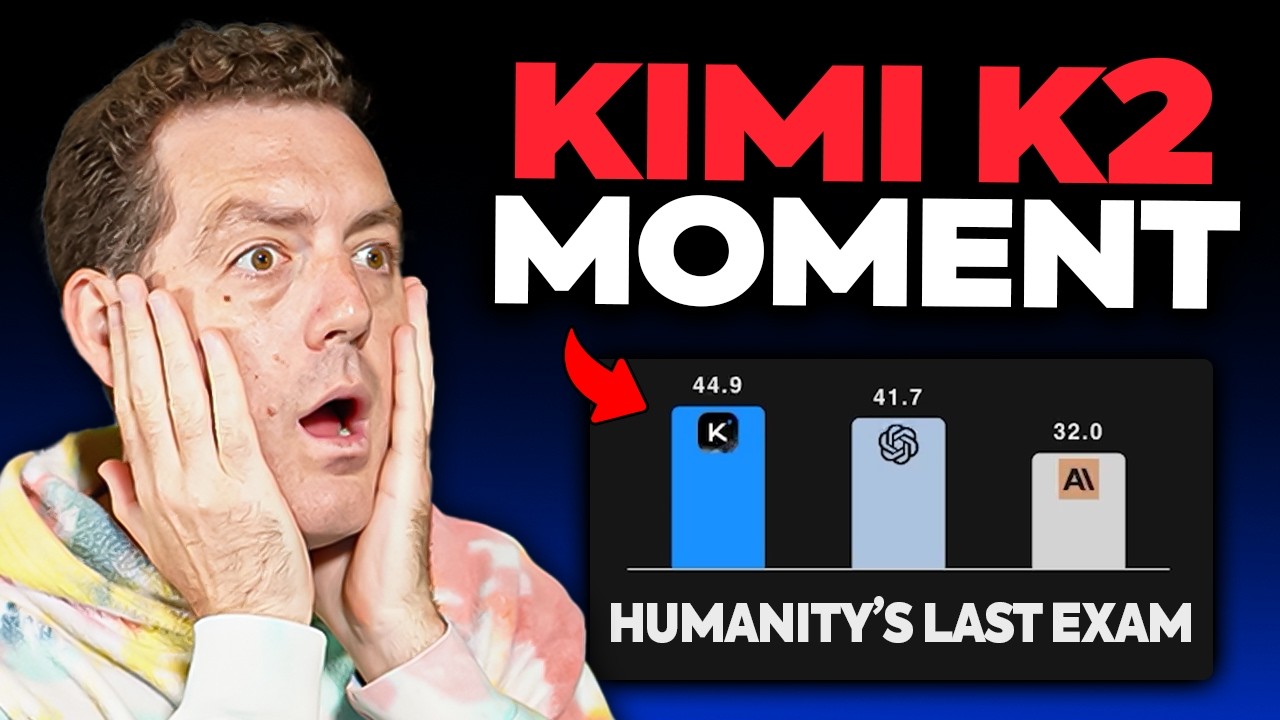
| Humanity’s Last Exam (one of the hardest AI benchmarks) | 44.9 | 41.7 | 32.0 |
| Browse Comp (agentic web search & reasoning) | 60.2 | 54.9 | 24.1 |
| SWE-bench Verified (software engineering) | 71.0 | 74.0 | 77.0 |
| Live CodeBench v6 (competitive programming) | 83.1 | 87.0 | 64.0 |
Notably, Kimi K2’s 60.2% score on Browse Comp is more than double the human baseline of 29.2%, proving its superior ability to navigate, search, and reason over complex, real-world web information.
Real-World Problem Solving: PhD-Level Math Example
In one stunning demonstration, Kimi K2 Thinking solved a PhD-level mathematics problem using a 23-step reasoning chain that included:
- Multiple internal reasoning phases
- Targeted web searches (e.g., “hypolic normal distribution PDF”)
- Iterative refinement based on retrieved information
- Final correct answer generation
The model didn’t just guess—it researched, hypothesized, validated, and concluded, mimicking the scientific method with remarkable fidelity.
Advanced Coding and Web App Generation
Kimi K2 Thinking excels at full-stack development from a single prompt. Demonstrated capabilities include:
1. Word Processor Clone
Generated a fully functional rich-text editor with features like:
- Bold, italic, underline, strikethrough
- Font size and type selection
- Local document saving via browser
2. Gradient Descent Visualization
Created an interactive mathematical visualization tool to explain machine learning concepts—ideal for educational content creators.
3. Virus Simulation Dashboard
Built a dynamic simulation of a virus attacking cells in a bloodstream, complete with user-adjustable parameters:
- Number of viruses
- Virus types (aggressive, stealth, fast-replicating)
- White blood cell count, speed, and detection range
- Interactive sliders for real-time manipulation
4. Vinyl Record Simulator
Designed a visual vinyl player where users can “drop the needle” to play a circular text animation (though audio was not implemented).
5. Live Music Generation with Strudel
Used Strudel—a code-based music generation language—to compose live music programmatically, showcasing creative coding prowess.
Complex Logical Reasoning Challenge
Kimi K2 was given a multi-layered logic puzzle:
“An individual is an alumnus of a university founded between 1860–1890, was a university athlete, briefly played professional American football, and starred in a sci-fi alien invasion film released between 2010–2020…”
The model executed a multi-turn reasoning loop:
- Initial hypothesis generation
- Web search for university founding dates
- Cross-referencing athlete and filmography data
- Iterative refinement based on new evidence
- Final identification: Jimmy Garoppolo Jr.
Training Cost and Efficiency Insights
According to Emad Mostaque (founder of Stability AI), the base Kimi K2 model was trained with:
- 2.8 million H800 GPU hours
- 14.8 trillion tokens
- Estimated cost: $5.6–6 million
The reasoning-optimized “Thinking” version likely required ≤20% additional cost for post-training, bringing total expenditure to under $3 million if trained on next-gen Blackwell chips.
This highlights a critical trend: frontier AI models are becoming dramatically cheaper to train, accelerating innovation and accessibility.
Kimi K2 vs. DeepSeek R1: Technical Comparison
With DeepSeek’s R1 release earlier in 2025, Kimi K2 represents the second major “open weights” breakthrough of the year. Here’s how they stack up:
| Feature | DeepSeek R1 | Kimi K2 Thinking |
|---|---|---|
| Total Parameters | 671 billion | 1 trillion |
| Vocabulary Size | 129,000 | 160,000 |
| Mixture of Experts (MoE) | 256 experts | 384 experts |
| Active Parameters (Inference) | 37 billion | 32 billion |
| Context Length | 128,000 tokens | 128,000 tokens (some reports suggest 256,000) |
Despite being larger, Kimi K2 is more inference-efficient—using fewer active parameters while delivering superior reasoning performance.
Expert Reactions from AI Leaders
Emad Mostaque (Stability AI)
“Congratulations to Kimmy Moonshot for achieving state-of-the-art on many benchmarks and open sourcing the model. The gap between closed and open continues to narrow… K2 has a unique vibe. Try it out.”
Nathan Lambert (Interconnects.ai)
“Early reports: it has a distinctive style in writing, which is very welcome… China’s rise is undeniable. At the start of 2025, few knew Zero AI Labs. Now, DeepSeek, Qwen, and Kimi are household names.”
Lambert emphasizes that Chinese AI labs closed the open-frontier performance gap in just 6 months—a stunning pace of innovation.
China’s Dominance in Open-Source Frontier AI
While U.S. labs like OpenAI and Anthropic keep models closed, and Meta has paused Llama releases, China is leading the open-weights revolution. Moonshot (Kimi), DeepSeek, and Alibaba (Qwen) are now driving the frontier of open, capable, and commercially viable AI.
This shift raises a critical question: Can these models carve out niches with real user demand? Early evidence—especially Kimi K2’s agentic strength—suggests yes.
Team Test: Healthcare Accessibility Analysis in Ghana
The video creator’s team tested Kimi K2 with a complex data science task:
“Analyze the relationship between population density and healthcare facility accessibility in Ghana. Download WorldPop data and health facility coordinates. Compute average population density within 10km of each facility. Rank top 10 districts by lowest per capita coverage. Generate map and bar chart.”
How Kimi K2 Executed the Task
- Generated a detailed to-do list in its internal “OK Computer” scratchpad environment
- Automatically browsed to WorldPop and downloaded population raster data
- Located and fetched open health facility datasets
- Performed geospatial analysis to compute coverage metrics
- Identified underserved districts
- Generated interactive visualizations
- Compiled a full report with methodology, data sources, and limitations
After just one piece of human feedback (“this part is a mess—debug and fix it”), Kimi K2 autonomously corrected errors and delivered a polished final product.
Final Output Included:
- Executive summary
- Interactive map with facility overlays
- District-level disparity charts
- Downloadable CSVs (facility analysis, district coverage, underserved areas)
- Methodology and data source documentation
How to Run Kimi K2 Thinking: Infrastructure Recommendations
To deploy and experiment with Kimi K2 Thinking, the video recommends Vulture—the world’s largest independent cloud provider. Key advantages include:
- Latest NVIDIA and AMD GPUs across 32 locations on 6 continents
- Lowest latency and industry-leading price-to-performance
- No vendor lock-in with fully composable infrastructure
- Vulture Kubernetes Engine for scaling beyond single containers
Readers can get $300 in free credits for 30 days by visiting getvulture.com/bman and using code bur300.
Creative Writing and Style
While the presenter admits skepticism about AI’s creative writing abilities, experts like Nathan Lambert note that Kimi K2 has a “distinctive style” that stands out—a rare trait in today’s homogenized AI landscape. This suggests potential for narrative, marketing, and literary applications beyond technical tasks.
Upcoming Developments
Moonshot Labs plans to release a dedicated “agentic mode” for Kimi soon. Additionally, the video creator’s team is preparing a full testing video with deeper evaluations—so stay tuned for more insights.
Additional Resources
For those looking to apply Kimi K2 Thinking in real-world scenarios, the presenter recommends downloading “The Subtle Art of Not Getting Replaced” ebook, which includes:
- 100 real-world AI use cases
- Practical prompts and workflows
- Industry-specific automation strategies
Where to Access Kimi K2 Thinking
The model is available at kimmy.com. As a fully open-weights model, it can be self-hosted, fine-tuned, or integrated into custom applications without licensing restrictions.
Conclusion: The Open-Source Frontier Is Here
Kimi K2 Thinking isn’t just another AI model—it’s a proof point that open-source, open-weights systems can now match or exceed the capabilities of closed, proprietary models from the world’s richest tech companies. With its unparalleled agentic reasoning, tool integration, and real-world problem-solving abilities, Kimi K2 represents a new era of autonomous AI.
For developers, researchers, and creators, this means unprecedented access to frontier intelligence without gatekeeping. For the AI industry, it signals that the race is no longer just about scale—but about reasoning depth, autonomy, and real-world utility.
The “Kimi Thinking Crazy” moment is real—and it’s open for everyone to use.