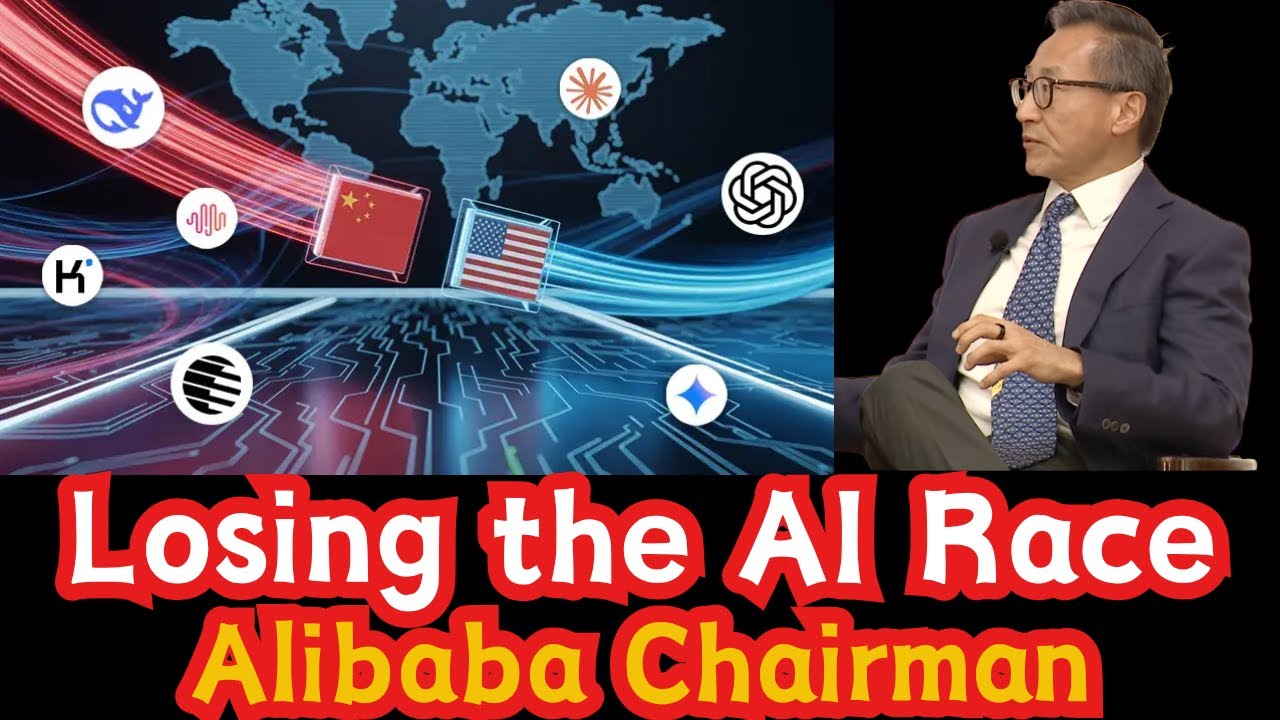
TL;DR: Alibaba Chairman Joe Tsai explains how China’s integrated AI strategy—combining government support, engineering pragmatism, energy infrastructure, open-source collaboration, and a vast talent pipeline—gives it a decisive edge over the U.
📋 Table of Contents
Jump to any section (19 sections available)
📹 Watch the Complete Video Tutorial
📺 Title: Alibaba Chairman: Why the US Is Losing the AI Race
⏱️ Duration: 2351
👤 Channel: Global Insight Hub
🎯 Topic: Alibaba Chairman Why
💡 This comprehensive article is based on the tutorial above. Watch the video for visual demonstrations and detailed explanations.
In a revealing discussion on global AI leadership, Alibaba Group Chairman Joe Tsai unpacks the strategic, structural, and cultural forces propelling China to the forefront of artificial intelligence innovation. Far beyond headlines about large language models (LLMs) and chip shortages, Tsai reveals a comprehensive national ecosystem that blends government vision, engineering pragmatism, energy infrastructure, open-source philosophy, and talent development into a formidable advantage.
This article distills every insight, data point, policy detail, and forward-looking recommendation from Tsai’s full transcript—offering a definitive guide to understanding why China’s AI strategy is succeeding, how it differs fundamentally from the U.S. approach, and what it means for students, entrepreneurs, and global enterprises navigating the AI era.
China’s Dominance in Global AI Talent: A Hidden Advantage
One of the most striking revelations is the sheer scale of China’s contribution to the global AI workforce. According to Tsai, “almost half of the AI scientists and researchers globally have had a degree from a Chinese university.” This holds true regardless of where they work—whether at U.S. tech giants like Meta, Chinese firms like Alibaba, or research institutions worldwide.
This talent pipeline has real-world consequences. Tsai cites a recent social media post from a non-Chinese employee at Meta (Facebook) who complained that his AI team “everybody is speaking Chinese and they’re sharing ideas in Chinese—he doesn’t understand.” While real-time AI translation tools exist, informal collaboration—watercooler chats, cafeteria conversations—often remains linguistically exclusive.
Historically, the Chinese language was a barrier to overseas expansion for Chinese companies. But in the AI domain, fluency in Chinese has become a strategic asset, enabling rapid idea exchange among the world’s largest concentration of AI-trained engineers.
China’s National AI Policy: Goal-Oriented and Market-Driven
Unlike purely research-focused initiatives, China’s AI strategy is defined by clear, measurable outcomes. Tsai highlights a recent directive from the State Council: “By 2030—just five years from now—China aims for 90% penetration of AI agents and devices.”
Critically, the government doesn’t dictate how this goal is achieved. Instead, it empowers both state-owned enterprises and private entrepreneurs to innovate freely. As Tsai explains, “They basically said, ‘Here’s the goal. We’ll let the market figure it out.’”
This approach shifts the metric of success from model benchmarks to real-world adoption. “The score is being kept by the adoption rate,” Tsai emphasizes. “The more people that adopt AI, the more society will benefit.” This focus on proliferation—not just performance—underpins China’s long-term AI advantage.
China’s AI Superpower Stack: Four Foundational Advantages
Tsai argues that the U.S. narrowly defines AI leadership by LLM quality (e.g., OpenAI vs. Anthropic), but China competes across the entire technological stack. He identifies four key pillars:
1. Energy Infrastructure and Cost Efficiency
AI is energy-intensive. Training and running large models consume massive electricity—making power availability and cost critical. China’s advantage here is structural and long-term:
- 15 years ago, China began massive investments in high-voltage electricity transmission infrastructure.
- State Grid (China’s power operator) spends $90 billion annually on capital expenditures—three times the U.S. total of $30 billion.
- China’s total electricity generation capacity is 2.6 times that of the U.S.
- China’s annual net additions to capacity are nine times greater than the U.S.—mostly in clean energy (solar, wind, hydro).
- Result: Electricity in China costs 40% less per kilowatt-hour than in the U.S.
“When you burn all these GPUs… you’re burning energy, lots of energy,” Tsai notes. Cheap, abundant power gives Chinese AI developers a significant operational edge.
2. Lower Data Center Construction Costs
Beyond energy, the physical infrastructure for AI is cheaper in China. Tsai states: “It’s 60% cheaper to build data centers in China”—even before accounting for hardware costs. This lowers the barrier to entry for AI deployment at scale.
3. Engineering Talent and Systems Innovation
While China faces GPU shortages due to U.S. export controls, Tsai argues this constraint has bred innovation: “Lacking in GPUs actually creates an advantage of starvation. When you don’t have a lot of resources, you are forced to innovate at the systems level.”
AI development isn’t just theoretical research—it’s deeply engineering-intensive. Optimizing systems to train trillion-parameter models efficiently requires vast engineering talent. China produces the most STEM graduates globally each year, feeding this demand.
4. Competitive Model Performance
Contrary to perceptions of a U.S. lead, Chinese models are closing the gap rapidly. Tsai cites a recent two-week contest involving 10 AI models (American and Chinese) tasked with trading cryptocurrencies and stocks:
- Alibaba’s Qwen model won the competition.
- DeepSeek (a Chinese startup) placed second.
“I actually think that the Chinese models are not very far behind the United States,” Tsai asserts, crediting both talent and systems-level efficiency.
The Open-Source Edge: China’s Secret Sauce for AI Proliferation
Perhaps the most consequential strategic difference lies in philosophy: China champions open-source AI, while the U.S. favors closed, proprietary models.
Alibaba, for example, publishes multiple open-source versions of its Qwen models on global marketplaces. Anyone can download and run them—for free—on their own infrastructure or even a laptop.
In contrast, U.S. companies like OpenAI charge significant fees for API access. Tsai argues this creates a fundamental adoption barrier: “The winner is not about who has the best model. The winner is about who could use it the best in their own industries and lives.”
Why Open Source Wins Globally
Tsai outlines two compelling reasons why governments and enterprises worldwide are leaning toward open-source AI:
- Cost Efficiency: No licensing fees enable rapid experimentation and deployment, especially in cost-sensitive regions like the Middle East or Southeast Asia.
- Data Privacy and Sovereignty: Using proprietary APIs means feeding sensitive data into a “black hole” with unknown storage or usage policies. Open-source models allow organizations to “set up their own private cloud to store data” and maintain full control.
For nations seeking “sovereign AI,” open-source Chinese models offer a viable, affordable alternative to U.S. black-box systems.
How Alibaba Monetizes Open-Source AI (Without Selling Models)
If Alibaba gives away its AI models for free, how does it make money? Tsai clarifies: “We don’t make money from AI. We run a cloud computing business.”
The monetization strategy is indirect but powerful:
- Running AI models requires sophisticated cloud infrastructure—storage, networking, security, containers, data management.
- Most companies cannot build this in-house; they rely on cloud providers like Alibaba Cloud.
- Alibaba offers a full suite of integrated cloud services optimized for AI workloads.
- By attracting users with free models, Alibaba drives adoption of its profitable cloud platform—achieving scale and operational leverage.
“It’s like hotels,” Tsai analogizes. “Individually, we don’t build our own hotels. We rent from operators who have the expertise and scale.” Similarly, AI infrastructure is a utility best delivered via cloud.
Future of AI: From Tool to Companion
Tsai envisions the next major transformation in AI: the shift from AI as a productivity tool to AI as a personal companion.
Today, AI helps us code faster or analyze data more efficiently. But the future lies in Artificial General Intelligence (AGI)—systems that pass the Turing Test by interacting so naturally that users “can’t tell if it’s a human being or not.”
When AI becomes a “friend” rather than a tool, it will fundamentally reshape human behavior, social dynamics, and business models. While this prospect is “exciting but also kind of scary,” Tsai believes it’s inevitable—and cloud computing will power this evolution.
Career Advice for the AI Era: Skills and Majors That Matter
Addressing an audience of 80% students, Tsai offers specific guidance on preparing for the AI-driven future. He separates advice into skills and subject-matter expertise.
Essential Skills to Cultivate
- How to acquire knowledge: In a fast-changing world, the ability to learn independently is paramount.
- Analytical thinking frameworks: Develop the capacity to process information and draw independent conclusions.
- Asking the right questions: Critical inquiry drives innovation more than rote answers.
- Coding (even with AI tools): “Learn some kind of computer code… The purpose is not to operate a machine. The purpose is going through that thinking process.” Coding teaches logical structuring of instructions—essential for understanding AI behavior.
- Spreadsheet mastery: “Constructing a formula in a spreadsheet… is a beautiful thing.” It trains systematic problem-solving and quantitative reasoning.
Recommended Academic Majors
Tsai identifies three interdisciplinary fields as particularly valuable:
- Data Science (modern statistics): With exponential data growth, the ability to manage and interpret data is crucial.
- Psychology and Cognitive Science: Understanding the human brain—the “most energy-efficient machine”—is key to designing human-aligned AI.
- Material Science: “The world is being dominated by bits, but what makes the bits move faster is going to be atoms.” Innovations in semiconductors and hardware will underpin next-gen AI.
“We still need to learn how to code not because we are needed [to write code], but we need to have logic in order to understand what AI is doing to us,” Tsai summarizes.
Was AI the Next Internet Bubble? Tsai’s Reality Check
Amid soaring stock prices of the “Magnificent 7” and NVIDIA, many fear an AI bubble. Tsai distinguishes between two types:
- Financial Market Bubble: Stock valuations may be inflated—this is possible but hard to predict.
- Real-World AI Phenomenon: The underlying technology is genuine and transformative.
He draws a parallel to the 2000 dot-com crash: “The internet bubble burst, but the internet itself was real—and is stronger today.” Similarly, AI infrastructure and models represent lasting value. “It’s not going to go to waste because it’s a real phenomenon.”
Startup Wisdom: Embracing Asymmetrical Risk
Reflecting on his decision to leave a lucrative Hong Kong job to join Alibaba in the late 1990s, Tsai frames entrepreneurship as a risk-reward calculation:
- Downside was limited: With a law degree, he could always return to legal practice.
- Upside was unlimited: The potential of the internet in China was vast and unexplored.
This created an “asymmetrical risk situation”—akin to a financial call option. His advice to aspiring founders: “The most important thing… is preparedness. You have to be prepared to seize that opportunity when it comes along. You don’t know when it’s going to come.”
China’s AI Policy vs. U.S. Approach: A Strategic Comparison
The transcript reveals a fundamental philosophical divide:
| Dimension | China’s Approach | U.S. Approach |
|---|---|---|
| Model Philosophy | Open-source, free access, community-driven innovation | Proprietary, API-based, monetized access |
| Success Metric | Adoption rate and societal integration (e.g., 90% penetration by 2030) | Model performance benchmarks (e.g., LLM leaderboards) |
| Government Role | Set ambitious national goals; let market execute | Export controls, research funding, but less centralized direction |
| Data Strategy | Emphasize data sovereignty via private cloud deployment | Centralized data processing via cloud APIs (privacy concerns) |
| Innovation Driver | Resource constraints → systems-level efficiency | Abundant capital → scale and compute |
The Role of Advanced Manufacturing in China’s AI Edge
Beyond software, Tsai notes that China’s strength in advanced manufacturing—a capability many developed economies have lost—provides a hardware foundation for AI. From semiconductor production to server assembly, vertical integration accelerates deployment and reduces supply chain risks.
Energy as a Strategic AI Resource
Tsai underscores that AI’s future is tied to energy sustainability. China’s early bet on ultra-high-voltage transmission lines enables efficient movement of renewable energy from remote generation sites (e.g., northern wind farms) to southern data hubs. This foresight—absent in the U.S.—creates a durable cost and reliability advantage for AI operations.
Global Implications: Sovereign AI and the Rise of Alternatives
For countries like Saudi Arabia seeking “sovereign AI,” Chinese open-source models offer a viable path. Without domestic AI talent, relying on U.S. APIs poses data security and dependency risks. Open-source Chinese models allow nations to build localized, secure AI systems—accelerating global AI democratization.
Alibaba Cloud’s Vision: AI as a Utility
Tsai positions cloud computing as the “electricity” of the digital age—ubiquitous, essential, and invisible. The next wave of cloud innovation will be AI-native, providing the infrastructure for everything from model training to AGI companionship. Alibaba Cloud’s integrated suite (storage, security, networking, containers) is designed to lower the friction of AI adoption.
Why Language Is Now an AI Asset
Historically, Chinese companies struggled overseas due to language barriers. But in AI, Chinese has become a collaborative advantage. With half the world’s AI researchers educated in China, Mandarin facilitates rapid knowledge transfer—a first in modern tech history.
Preparing for the Human-AI Symbiosis
As AI evolves toward companionship, understanding human cognition becomes as important as coding. Tsai’s emphasis on psychology and biology reflects a belief that the future belongs to those who can bridge machine intelligence and human needs—designing AI that augments, not replaces, human experience.
Key Takeaways: China’s AI Winning Formula
- Adoption over benchmarks: China measures AI success by real-world usage, not just model scores.
- Open-source as strategy: Free models drive cloud adoption and global influence.
- Energy = AI fuel: Cheap, clean power is a non-negotiable infrastructure advantage.
- Talent at scale: Half the world’s AI researchers trained in China—a self-reinforcing ecosystem.
- Systems innovation under constraint: GPU shortages forced efficiency breakthroughs.
- Government-market synergy: Clear goals + entrepreneurial execution = rapid scaling.
Final Thought: The AI Race Is Won by Users, Not Just Builders
Tsai’s core message is transformative: “The winner is not about who has the best model. The winner is about who could use it the best.” China’s focus on proliferation—through open access, low costs, and practical integration—positions it to lead not in labs, but in factories, hospitals, schools, and homes. As students and entrepreneurs prepare for this future, the skills that matter most are those that bridge human insight and machine capability—ensuring AI serves society, not the other way around.